Showing posts with label garlic. Show all posts

Cod en Papillote with Rosemary Walnut Tapenade and Pan Seared Zucchini


Parchment is one of your kitchen BFF's. Especially when you want to delicately cook fish. 'En papillote' just means 'in parchment' in French. 'Al cartoccio' is the Italian equivalent. Cooking en papillote is so easy because it does the work for you. I'm a fan of any process where I can do little work and still produce a delicious meal. 

You'll want to start by making your tapenade, an olive spread originating in France. In a food processor, combine 1T of drained and rinsed capers, a 12" sprig of rosemary, 2 garlic cloves, 1T of anchovy paste, 1/4 cup of toasted walnuts (heat in pan over medium high heat for 5-7 minutes or until you can smell them), 1T of black pepper, and 2 cups of rinsed black olives. Pulse until you have a thick paste, then add the juice of 1/2 a lime, and slowly stream in 1/4 cup olive oil. Though you may be tempted to add a pinch of salt, DON'T. The capers are packed in brine. The olives are packed in brine. And the anchovy paste is made from salted, preserved anchovies. That's a lot of salt already, so no need to add any more or your tapenade will most likely be inedible. Cover with plastic wrap and leave it on the counter while you prepare your fish. 


To prepare your fish, preheat the oven to 400 degrees F. Take a 24" sheet of parchment and lie it on a baking sheet. Place two, 6oz. cod fillets in the middle of the parchment width-wise and place it lengthwise so that there are 8" of paper on one side, and 12" on the other. Drizzle with olive oil and 1tsp of honey. Add 2tsp of chopped rosemary and a pinch of black pepper. First fold the 8" piece over the fish, then do the same with each of the side pieces of parchment. Take the remaining 12" piece and crimp it in 1" folds under itself so that it is tucked under the fish. Cut a slit in the top of the parchment to let the steam out and bake for 25 minutes or until fish flakes apart easily. 


Finished product:


The zucchini is so simple, even a caveman could do it. Or your husband or wife who's never cooked a day in his/her life. Heat 1T of butter in a pan over high heat. Season the butter with a pinch of black pepper. Chop one 10" zucchini into 10 equal pieces and place the pieces flat into the pan. Cook on each side for 7 minutes or until golden brown. 


Serve the zucchini and fish hot with the tapende as the garnish. 


This normally robust cod is delicately cooked to succulent perfection. The honey only highlights the already sweet fish, and the tapenade is intensely tangy with a pungent flavor that overpowers your taste buds in a fantastic symphony of sharp tones. Lastly, the purity of the seared zucchini is a perfect compliment to the main dish. Buon appetito!

Herbed Chicken Noodle Soup


Chicken noodle soup is right up there with mac and cheese, mashed potatoes, and chocolate in the comfort food lineup. There's just something soothing about a warm bowl of soup. Who can resist protein-filled broth infused with herbs, soft noodles, delicate veggies, and tender chicken? I certainly cannot...

Start by heating your oven to 375 degrees F. In a large soup pot, heat 1T butter, uniformly chop 4 large celery stalks, 4 large carrots, and 2 large yellow onions; add this mirepoix (meer-pwah) to the pot, and sauté until all the veggies are soft. While the vegetables are cooking, combine 1/2 stick room temperature butter with 1T chopped fresh sage, 1T chopped fresh thyme, and 1T chopped fresh rosemary in a small bowl. Add a pinch of salt, and a few cracks of black pepper to the butter. Place your whole chicken in a large dutch oven or cast-iron pot. Now take the herb butter and use your hands to rub it under the skin of the chicken, making sure to coat the breasts as well as the legs. Rub any remaining butter on the outside of the chicken. Quarter an additional yellow onion, cut 2 more carrots into thirds, and stuff them into the cavity of the chicken; leave any onion or carrot pieces that won't fit inside the bird in the pot. Then fill the pot halfway up the chicken with a dry red wine. I used cabernet sauvignon. Cover and bake for 1.5 hours or until the internal temperature of the chicken at the thickest part reaches 165 degrees F. 


 Once your mirepoix has finished cooking, add 2 quarts of low-sodium chicken broth to the pot and bring to a boil. Add 2T each of chopped fresh parsley, sage, rosemary, and thyme (hello Simon & Garfunkel) to the broth. (TayTip: to infuse your broth with another layer of flavor, finely chop and add the celery leaves from your stalks. They really drive home the tangy flavor of the celery.) Once your broth is boiling, add 3/4 of a large bag of egg noodles; one whole bag if you like your soup extra noodle-y. Add 2 1/2 tsp of salt, and 1T of cracked black pepper. Cook until the noodles are al dente, then reduce the heat to warm. When your chicken has finished roasting, remove it from the dutch oven, and place it on a cutting board to cool for 15 minutes so that you won't burn your fingers when chopping it. Pour the cooking liquid from the chicken into the broth with the noodles. When your chicken has cooled, remove the breast and leg meat, dice into whatever size you like, and add to the soup. 


SIDE NOTE: This is also the exact same base for chicken and dumplings. Instead of adding egg noodles to the boiling broth, mix 2 cups flour, 1T baking powder, 1tsp salt, and 1tsp pepper with 1 1/2 cups water until you have a batter. It should be thicker than pancake batter, but thinner than biscuits; add water or flour respectively depending on whether the batter is too thick or thin. (TayTip: this is basically Bisquick  minus the shortening. Use your favorite flour--all purpose, wheat, buckwheat, spelt, semolina--and quadruple the recipe without water. Keep it in an airtight container and use as the base for pancakes, dumplings, biscuits, waffles, etc. Homemade Bisquick at hand and much cheaper!) Take a large spoon and drop the dumplings right into the boiling broth so they form a layer on the top. Reduce the heat to low, and simmer for 15-20 minutes until your dumplings are cooked all the way through, but not dried out. 


The fresh herbs really are the stars of this soup. They add a flavor complexity that nothing else can. The combination of sage, rosemary, and thyme with parsley is that signature smell of savory Fall cooking. It instantly takes me back to Thanksgivings or Christmases growing up. Hearty, warm, scrumptious, and just what you need to say 'hello' to Fall. If you even have any leftover, you can pop it in a container and freeze for an entire season. Perfect for tailgates, if you're sick, rainy days inside, or anytime! Forget your soul, this chicken noodle soup is for your stomach. Buon appetito! 

Snacketizer Part Three: Roasted Red Pepper Hummus


Part three of four! Hummus is right up there alongside guacamole and salsa as a quintessential dip. It's also incredibly simple, and you only need a few, key ingredients (that most people already have in their kitchens) to make it.

Start by draining and rinsing two 15oz. cans of chick peas. This gets rid of the salty water that they're packed in. Toss them into a food processor with 2T of sesame oil and the juice of 4 small limes, which is about 1/2 cup. (TayTip: since limes don't have seeds, use the top of the blade in your food processor as a citrus reamer to get the most juice out!) Hummus is traditionally made with tahini paste, which is just ground sesame seeds, but I find that the sesame flavor isn't as prevalent when using tahini. Thus, the reasoning for the oil instead. Pulse until the chick peas are broken down. 


Next add two whole roasted red peppers. These are red bell peppers (not hot) that have been roasted over a flame or under a broiler. The best way to make your own is if you've got a gas stove with an open flame, but since mine's electric, I buy them in the jar. They're packed in a vinegar and water mixture, so drain them and toss them into the processor with 2tsp of salt and 2tsp of black pepper. Then add two garlic cloves and puree until the chick peas are broken down further. Depending on whether you like smooth or thick, you can add more olive oil, but no more sesame oil because the flavor would be too overpowering. I just love the color that the peppers add. If you look in the picture below, you can see the difference in where the peppers are incorporated/not incorporated into the hummus yet.


Perfectly smooth with a  mildly sweet, charred flavor from the peppers. It tastes like you threw in the good kind of flavor that a grill imparts. The sesame oil adds an unexpected toasty aroma, and the lime juice gives a nice pucker. Chick peas are virtually flavorless, so it's important to build a complex profile with these different ingredients. Serve with chips or crudité.


Questions, comments, and recipe requests below! Buon appetito!

Roasted Spaghetti Squash with Crushed Tomato Marinara and Sweet Italian Sausage


Let me just preface this post by saying that never-have-I-ever had a substitute for spaghetti that was this good.  And I was raised on pasta. As in, we had it more than one night a week growing up. Pasta definitely fills you up and tastes delicious, but the problem with eating a main course that is mostly carbs is that you feel hungry a LOT sooner after eating. That's why balancing fiber and protein in your meal is imperative. This low-carb dinner does the trick!

Roll up your sleeves, and start by prepping your squash. Just a warning: this is hard. If you've ever tried to carve a pumpkin, or cut a butternut squash, you know how tricky gourds can be. Just take your time and be careful; it's easy for your knife to get away from you when slicing through the flesh of the squash. Cut your spaghetti squash in half lengthwise until you have two pieces. Take a spoon, and scrape out the seeds, but don't throw them away; you can season and roast them for a perfect snack or in salads! Recipe for that to come later. You can see the delicate strands that make up the flesh of the squash. Season with olive oil, salt, and pepper, place them flesh side down on an oiled cookie sheet, and set in a 400 degree F oven for 30-35 minutes. 


While your squash is roasting, it's time to make the base for your crushed marinara. The texture of this sauce is incredibly substantial, and when you don't have the real pasta, you'll want something with a little bite to it. Melt 1T butter in a non-stick saute pan over med-high heat. Dice 1 large white onion, and 4 medium cloves of garlic and add to the pan. Cook until onions are somewhat caramelized and translucent. Then chop 7 large, vine-ripened tomatoes and throw in the pan with the onions. Add 1tsp salt, 1tsp ground black pepper, 1/2tsp crushed red pepper flakes, and 2tsp dried Italian herbs (these usually have oregano, basil, thyme, etc.). Cover and reduce heat to medium; cook for 20 minutes, using the back of a wooden spoon, periodically, to break down tomatoes. 


In a separate pan (I use a cast iron skillet), brown 5 large, sweet Italian sausages over high heat. (TayTip: to cook perfect sausages, always have a full measuring cup of water next to the pan. Pour about 1/2 cup in with the sausage. This allows them to cook more evenly without burning the outsides. When the water evaporates, add more. Continue this for approximately 15 minutes, then let the last batch of water evaporate and brown up the outside edges of the sausage.) Transfer the entire contents of the marinara sauce in with the sausage, and reduce heat to low. Cover, and simmer for an additional 20 minutes. The sausage will finish cooking in the sauce, but depending on your pans and stove, you'll want to make a small incision in the middle of one to make sure they're fully cooked (no longer pink). 


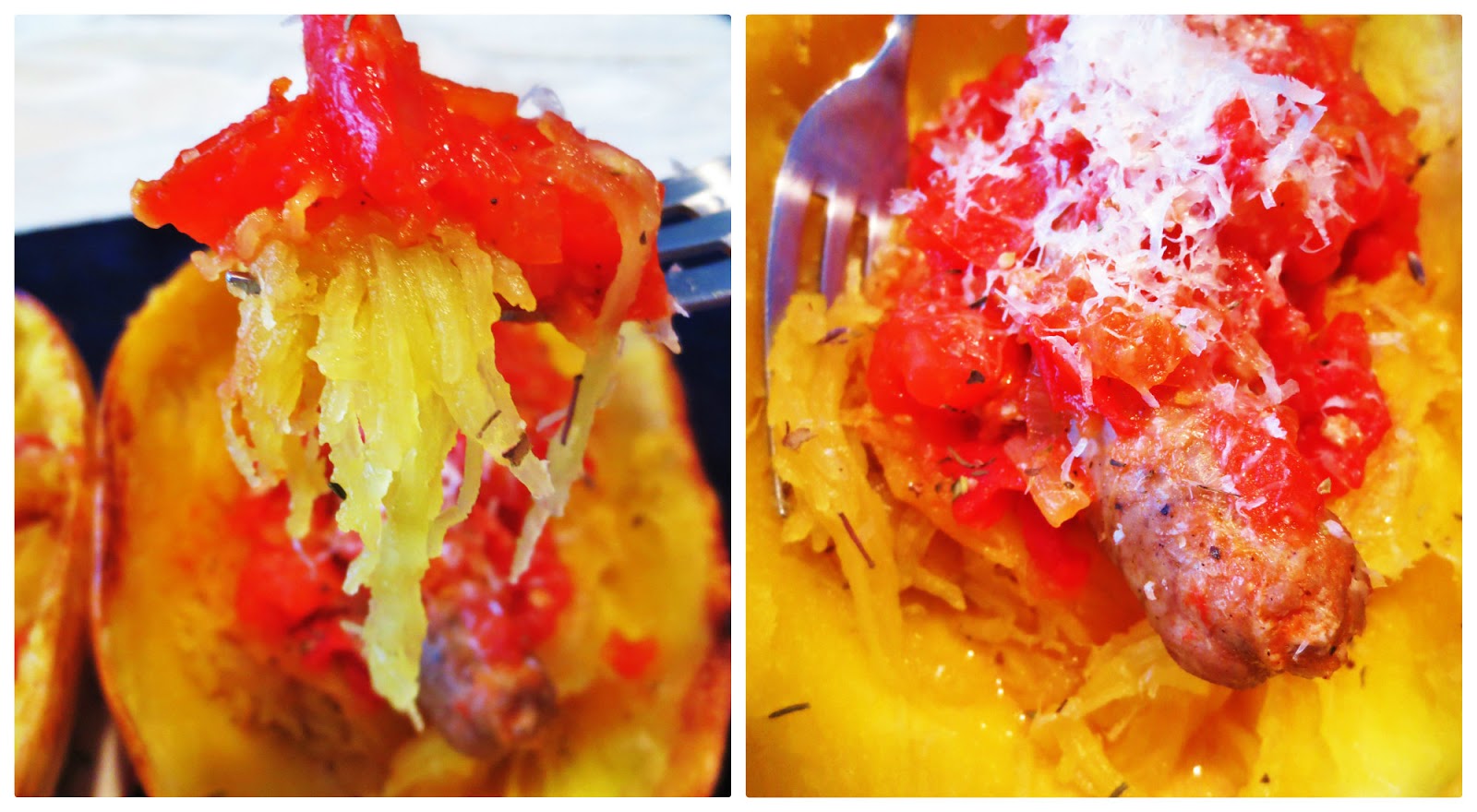
When your squash is done, remove from the oven, and let it cool for 10-15 minutes. Once cool, take a large serving spoon, and scoop the strands from the skin. Transfer to a large bowl and drizzle with 1T olive oil. Salt and pepper to taste. See the strands! Just like real spaghetti!


When the sauce has finished cooking, I like to scoop some of the squash strands back into the skins to serve. They're just like bread bowls from Panera, and make for a great presentation. Top with as much grated parmigiano reggiano as your little heart desires. 


This is a great meal to show off your ingenuity in the kitchen. You'll be amazed at how great a substitute it is for actual pasta. The squash is not overcooked (nobody likes mushy baby food), and gives a little resistance when biting down. It really doesn't have much of its own flavor. You get a little bit of a pumpkin/butternut squash flavor, but for the most part, it takes on the taste of the marinara, which by the way is perfectly savory. Sometimes when I make marinara, I'll add a little bit of honey to offset the acidity, but given the natural sweetness of the squash (and the sausage), I decided not to. The tomatoes are crushed and smushed and wonderfully hearty with a nice kick from the crushed red pepper. And lastly, the sweet Italian sausage. If you've had it, you know what I'm talking about. If you haven't, go buy some. These are from this wonderful shop in Arlington, VA, that my grandma used buy from when she lived there. She used to serve these for Christmas dinner with spaghetti and meatballs or her famous lasagna. The gentle fennel seed flavor is really the mark of a good sweet sausage, and it comes through with stunning clarity against the other flavors.  This is such a great meal. I felt fully satisfied, wasn't hungry later, and heck, anytime you can use a vegetable in place of a grain, I'm definitely in. 

Questions, comments, concerns below. Buon appetito!

Peanut Lime Chicken with Yellow Squash and Zucchini Cakes


One day a package of chicken met a jar of peanut butter and made this little baby. What a crazy match they were. I mean, they barely knew each other and now they had just jumped into this life-long commitment together? Well it wasn't that long of a life because I ate them. Quickly. There's something shockingly magical about the combination of sour lime and creamy peanut butter. And, summer squash in all of its forms is a fabulous. PLUS, this is great way to sneak extra protein and veggies into your family's diet! 

Start by heating up 2T of coconut oil in a large skillet over med-high heat. Coconut oil has a mild flavor, and I've always found that it smells more like coconut than it tastes like it. I get more hints of vanilla than I do coconut. Try to get the virgin, cold pressed kind if you can. Next, slice 5 chicken breasts lengthwise into 1/2 inch strips. I use a meat cleaver, but if you don't have one, you can use any non-serrated knife. Trim any fat left on the meat. Season with salt and pepper and toss in the pan. 


Then dice 6 small garlic cloves as small as you can get them. Throw half of the chopped garlic into the pan with the chicken, and reserve the other half for your squash batter. Cook the chicken for about 8-10 minutes, or until almost cooked. When the meat is still slightly pink in the middle, add 1c peanut butter. I used creamy because it's what I had, but chunky works just as well, and would add an ever better texture. (TayTip: if you or your family/friends have a peanut allergy, there are a variety of other nut butters out there that will work. If you end up using walnuts or brazil nuts, add 1T of honey to the sauce to cut the bitterness.) Work the peanut butter around the chicken. It will take a couple minutes to melt and smooth out. To keep it from burning in the pan, add 1c chicken broth; this sauce will seem runny at first, but will reduce and become thicker. Depending on the type of peanut butter, you might have a lot of the separated oil from the peanuts. Skim that off the top if that's the case. Lastly, add the zest of 1 lime; about 2T. Cover, reduce the heat to low and simmer for another 15 minutes. 


Now onto make your yellow squash and zucchini cakes. This is a variation on a meal that is very close to my heart and reminds me of  my childhood. My great-grandparents had a farm in Petersburg, VA, and had a fairly expansive garden. PaPaw made breakfast every morning, and I can't tell you how many times I woke up to the smell of zucchini fritters frying in the pan. He'd pick 'em straight from the garden, and make us eat vegetables for breakfast, and everyone loved them. Hotz family cousins, you know what I'm talking about! So these cakes are like his, but a little different. It's important to not think of these as a vessel for the chicken. They have to tell their own story and depending on the direction you want to take your meal, have to have the ability to stand on their own. Start by grating 1 medium zucchini and 1 medium squash. You can use a food processor with the grater plate, or use a box stand grater like I did. (TayTip: the rule of thumb--pun intended--when hand grating is to stop when there's about a 1.5 inch stub. It's not worth losing the finger. Plus now you have something to munch on while cooking!) Now add your reserved garlic from earlier, 1/2 chopped white onion, 1/4 cup parmesan cheese (Remember when I said here that there was a time for the kind with the green lid? This is that time), 2c whole wheat flour (obviously use whatever flour you typically use for allergies or your lifestyle, but check the conversion chart if going gluten free), 1/2c cream, 2tsp salt, and 2tsp pepper. Depending on how much water was in your squash and zucchini, you may need to add more flour to balance the batter. It should be thicker than pancake batter; kind of like muffins. Now turn the oven to 350 degrees F. It's important to not preheat your oven for this cake. I've found that it makes a moister cake if you let the cream and water from the squash slowly bake and come up to temperature, rather than shocking them in a scorching oven. Butter and flour a 9x9 baking pan, add your batter, and sprinkle a little more cheese on top. Bake for 20 minutes or until a toothpick inserted in the center comes out clean, just like brownies or cupcakes. 


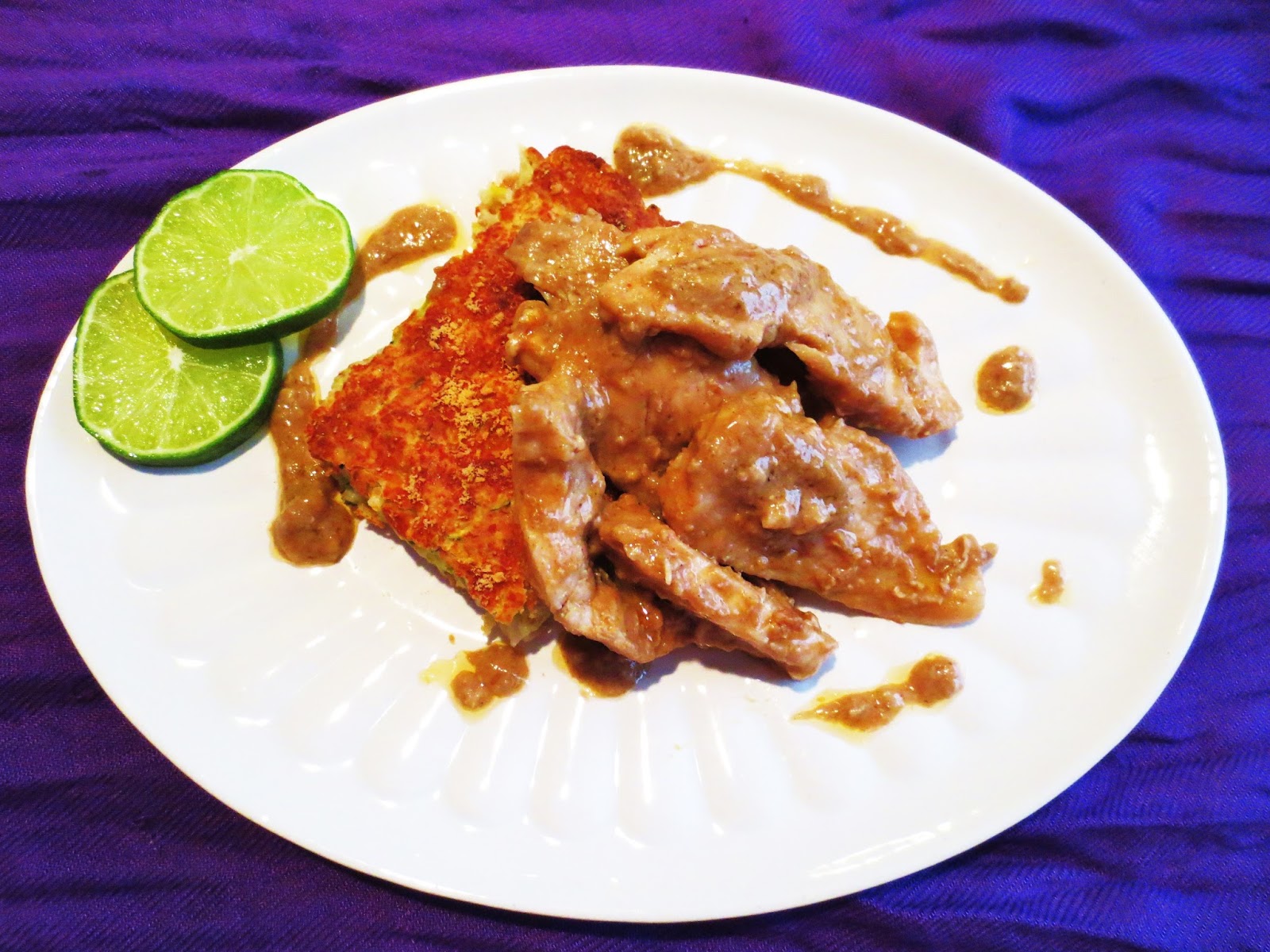
While your cake is baking, take the lid off your chicken and add the juice of 2 limes to the pan. The sauce will be quite thick, so this helps to rejuvenate it. Once the cake is done, cut it into 9 rectangles and serve the chicken on top. 


I consider this a kid-friendly meal; the cakes are great for snacks, and there aren't too many complex ingredients or conflicting flavors. When you taste them, you'll know what I'm talking about. The chicken is tender has a little bit of the original crust from searing it. The zest gives the initial intense lime punch, but it's softened by the peanut sauce, which is surprisingly balanced, and not too heavy. The polish of lime juice at the end perks up the whole meal. You could also use the chicken in a multitude of other ways: inside a wrap with your favorite veggies, tossed with pasta, on top of a salad, or maybe in an Asian stir fry with bean sprouts/corn/broccoli. For me, yellow squash and zucchini go together like PB&J, and the cakes are dense on the inside, and have a perfect crust on top. They stick to your ribs a little! They're not too overpowering when served with the chicken, but definitely could stand on their own. Plus, if you're dealing with picky eaters, you could always do what my mom did to make me eat my vegetables: say they're getting cookies, but they're really cucumber cookies ie. sliced cucumber. Tell them it's cake (not squash cake) and see if they complain! 

Comment below and tell me what you think! Did you make this recipe? Any allergies or dietary needs/restrictions and need more suggestions for substitutions? Let me know and we can brainstorm. Buon appetito!

Slow Cooker Boneless Short Ribs with Walnut Basil Pesto


Can we just stop to have a little applause for alcohol? I mean is there anything that it can't make taste phenomenal? Seriously. And not just any alcohol, wine. White in this case. When it comes to wine and meat, they're basically a match made in culinary heaven. Ok, let's be honest, anything cooked with alcohol is a match made in  culinary heaven. I don't have a problem, I promise! Try incorporating wine into the cooking process of your next dinner (and I don't mean drink it while you're cooking, although that is an acceptable practice in my book 99% of the time) and taste the insane flavor it imparts. You can't beat it. Nothing can mimic that taste. 

Since I made fish earlier this week, and that's usually what we have on Fridays for dinner, I decided to go the opposite direction and cook some good ol' red meat. I saw some boneless pork short ribs and decided they looked impeccable. And let me just tell you, the slow cooker is a godsend when cooking pork. Like scrambled eggs, they're best cooked slowly. Giving the connective tissue time to break down over a period of time in the cooker produces a juicy and tender rib (TayTip: get your butcher to leave a little bit of marbling--the white fat--on the ribs if you know you're not going to be cooking them for a couple of days. The fat helps retain moisture within the muscle). BUT, you always have to have a good flavorful topping/sauce to go with your ribs. I wasn't really feeling typical BBQ sauce, so I decided to make my pesto. Incorporating pesto with meat is a great use of this versatile Italian sauce. So let's start there...

This pesto is the traditional recipe that originated in Genoa, Italy, except for one ingredient. The name literally means to pound or crush, referencing the conventional preparing vessel used: a mortal and pestle (see the same prefix?) A mortal and pestle is currently on my wishlist, so I use a food processor. Doesn't give as rustic a consistency, but it does the trick. So, put about two cups of basil leaves, the juice of 2 small lemons, and 4 raw garlic cloves into your processor and pulse until the basil is broken down. 


Now for the salty part: freshly grated parmigiano reggiano. This is not the stuff in the bottle with the green lid, which can be good for other recipes, but not this one. The difference is that parmigiano reggiano is made under strict Italian Denominazione di Origine Controllata ("controlled designation of origin") laws--kind of like the USDA. You know how champagne can only be called such if it's made in the Champagne region of France? Same thing with parmigiano reggiano. It must follow the rules and be made in certain regions in Italy; Parma, Reggio-Emilia, and Modena to name a few. SO this is the real deal good stuff! You'll need about 1/4 cup grated right into the processor. Pesto is customarily made using pine nuts, but I didn't have any, so I decided to toast some walnuts and throw them in instead (TayTip: chefs often do, and you can make non-traditional pesto using different herbs and nuts. I've done sage and almonds before and it turns out great, so don't be scared to deviate a little. Especially if you have an allergy to a certain nut). The last step is to add a small pinch of salt because the cheese is very salty, some pepper, and turn the processor to the "ON" position. As it's running, slowly stream in 1/2 cup of olive oil. It should be somewhere between a loose vinaigrette and a paste, but you can tweak the oil and add more or less depending on how you like your consistency. 


 Put it in a container or bowl and drizzle more oil on top; you always want to cover leftover pesto with oil to keep it from drying out. This can obviously be used in a plethora of different dishes: pasta, salads, as a marinade, or simply as a dip with veggies or your favorite chips/crackers.  Let it sit in the fridge until you're ready to eat it with your meat. 

Speaking of which, let's move onto the meat. Start by quartering 1 1/2 medium white onions and roughly chopping 4 garlic cloves. Place your ribs in the slow cooker and season with a pinch of salt, couple twists of black pepper, and drizzle with a little olive oil. No exact measurements needed here, but don't put too much oil. The pesto already has oil in it, and the meat has fat on it. Then wiggle 2-3 stalks of fresh rosemary and thyme, respectively, on the bottom of the pan. Don't worry about removing the leaves or sprigs because they will be submerged and fall off in the cooking process. Throw your onions and garlic in, and sprinkle with 1tsp of crushed red pepper flakes. Then tuck your little piggies in with a nice blanket of Pinot Grigio. 2 cups to be exact. They won't be completely covered at the start, but will cook down. Set the cooker on high, cover, and let it work its magic for 4 hours. 


The pork just melds with all of the delectable elements in the cooker. It's important that the meat have a flavor element of its own, and not just take on the flavor of the pesto. So, that's why the herbs (whose stems you can fish out of the cooker at this point) onions, garlic, wine, and red pepper flakes are key players on the field. There will be a lot of broth left in the bottom of the cooker. DON'T throw that away. Put it in a container and freeze it; the next time you get sick, you'll have a good broth packed with vitamins and protein. Once the meat is finished, it will fall apart slightly. 


For two reasons that stand out to me, this is probably one of the best dishes you can make. One, it's done in the slow cooker and you can get on with your life while it's working away. And two, you just can't beat the flavors of wine and fresh herbs. The pork is so tender you could cut it with a wooden spoon. It tastes like the crisp pinot grigio and the sweet undertone of the onions. The smell of the rosemary and thyme remind me of Thanksgiving, but paired with the basil pesto, there's no mistaking this is a summer dish. The tang of the lemon is also pretty prominent in the sauce, and toasting the walnuts takes away their bitter taste, so they do well in replacing the pine nuts. These are pork ribs taken up a notch without the gloppy BBQ sauce. Who needs all that heaviness when you can have juicy meat topped with the lightest freshest sauce around? Buon appetito!

Broiled Cod with Sweet Onions, Cherry Tomatoes, and Tzatziki Sauce


With summer winding down, I realized that other than a salmon cake fiasco a couple months ago, I hadn't made a really good fish yet. I wanted to broil something with the gorgeous cherry tomatoes my aunt grew in her garden. Side note: I have to give a shout out and thank you to my Aunt Happel for bringing me a great assortment of some magnificently verdant fresh herbs (thyme, sage, rosemary, and a big bunch of basil--I'm feeling some short ribs with a pesto rub coming to a blog near you very soon) and some glowing, crimson tomatoes. You can't beat home grown! So back to the fish:  when it comes to fish and broiling, you really need something like cod or catfish that will hold up to the high temperature and won't turn into mush like flounder or tilapia would. I also recently saw some very enticing dill fronds at the store, and bought them in bulk, so I needed a dish to utilize them before they weren't fresh anymore. That's where the tzatziki sauce comes in (explanation below). So with the stars aligned, I set out to avail myself of all these fresh ingredients whose powerful flavors go a long way!

The first step is to crank the heat on your oven to broil (or 500 degrees F); you want it very hot when the fish goes in. Then take one large sweet onion, and cut it into about 1/3 inch slices. You want about 9 or 10 altogether. Then line the discs in rows of 3 on a baking sheet drizzled with extra virgin olive oil. Lay your cod fillets on top and toss some cherry tomatoes around the sheet. Drizzle with a little more oil, pinch of salt and a few cracks of pepper. Squeeze half a lemon all over and toss the half onto the sheet. It will perfume the oven and help the lemon flavor to permeate more. Then take some fresh thyme sprigs, remove the leaves (TayTip: you can easily remove the leaves by pinching one end of the sprig and stripping them off with the index finger and thumb of your other hand. Make sure to go "against the grain." You'll be able to tell if you need to run your fingers the other way.) and sprinkle freely on top of the fish. Thyme has a subtle lemony taste to it, so it compliments the lemon juice very well.  Take some aluminum foil and tent it over the top of your baking sheet. This keeps some of the steam in to keep the fish from drying out and helps the thyme from burning too quickly. Broil for about 10-15 minutes, but keep an eye on it because it goes fast. Your fish should be white and flakey when done.


Now for your tzatziki (pronounced zad-ZEE-kee) sauce.This is a classic Greek dish and is traditionally served with kebobs, inside gyros, or merely as a first course with pita bread. This is literally one of the easiest sauces you will ever make. It only has five ingredients! Let me say that again, FIVE! Excluding salt and pepper, which don't really count because they're in everything. You will be able to make this sauce with time to spare in the time it takes the cod to cook. Tzatziki is traditionally made with fresh mint and parsley along with the dill, but I don't like too many conflicting herbs in mine (because when they're fresh, they have a much stronger flavor as opposed to dried), so I went a little off the beaten path. It also customarily calls for olive oil swirled in (not fully incorporated), but I find that's only really necessary when serving it as a dip with pita bread. 

First start by taking two big handfuls of dill--about 1 cup--and remove the larger stalks at the bottom. Run your knife through the bundle a few times, enough to break it up. Next take one large cucumber and dice it small. Then zest one lemon. In a large mixing bowl add 3 cups of greek yogurt and incorporate your three previous ingredients. Then finely mince 7-8 small or 3 large garlic cloves and mix well. If you like more or less of any ingredient, add or subtract to your desire. You're the one eating it! Salt and pepper to taste and you're done. 


This is probably one of the easiest, yet most flavorful dishes you can make. And let's face it, when it's the middle of the week, you want something filling and scrumptious that you can prepare quickly.


The first thing I noticed about the flavor of the fish was that the sweetness of the onions and tomatoes really pops in the forefront, which is surprising since this is a savory dish. Top it with the tzatziki and it's exceptional. Cod really has the springy texture of lobster or crab claw meat when cooked. It gives a tiny bit of resistance when you bite down, which is what I meant when I said it doesn't turn to mush. The thyme is just subtle enough to boost the lemon flavor that is prevalent throughout. The tzatziki has a little zing from the fresh garlic, and isn't heavy at all because of the brightness that the lemon zest and juice bring. The slightly sour dill tastes like a mix of parsley and fennel, and adds a great depth of flavor. Plus, you can't beat the crunch of a fresh cucumber! I'm not kidding when I say this is a very easy and fast dish to make. If you want a perfect summer fish dinner, this is the way to go. Fresh, light, and satisfying. Buon appetito!


Mom's Crazy Little Mix: Egg Scramble with Ham, Gouda, and Sauteed Veggies


Most mornings, I make breakfast for my family. Let's face it, I usually make lunch and dinner too! My mom is particularly a fan of eggs--scrambled, omelettes, fried, frittatas, etc.--so I typically make some sort of egg dish with our breakfast for her. I, on the other hand, have an egg intolerance. I'm not sure if it's mentally or physically rooted, but they make me feel sick to my stomach if I eat them. As a cook, that's a double bummer for me because they're such a versatile ingredient, and I don't get to enjoy the fruits of my "labor." Besides, cooking is not only about nourishing your body and having a creative outlet, but is also mostly about the love you put into it for the people you cook for (even if it's just for yourself). 


So anyway, there's this running joke in our family that when my mom cooks, she's very free with whatever ingredients she has, putting things together that you wouldn't normally expect to be in a dish. When I ask her what she made, she'll usually reply with "Uhh I don't know, it's a crazy little mix." And 9 times out of 10, it's fantastic! I have to say that I admire her for that, and am so thankful that she did that while we were growing up because it taught me to not be afraid of cooking. It taught me to be creative in the kitchen, and to just make things up and see if they taste good; try two things together that you wouldn't typically pair with each other and just go for it! Like dark chocolate and brie, for example (Which I've done...go try it now. It's delicious.). Those are two ingredients you wouldn't expect to taste good when combined, but let me tell you, the creamy and slightly salty brie with the strong and partially bitter dark chocolate is ridiculously delectable. So the trick to this recipe is to get a little unconventional. Change it around to your liking and add one ingredient you wouldn't normally use! Ok, here we go...


Start by melting 1T butter in a pan over med-high heat and adding 1/4 finely diced red onion. Grind a couple cracks of pepper in the pan. (TayTip: don't add salt to your onions when sauteing. This makes the water seep out of the onions and you won't get a good browning, but rather they will steam in their own liquid.)


Then grab two large handfuls--about 4 cups--of mesclun greens or baby spinach and add it to the pan. I know this seems like a lot, but they will wilt down to almost nothing, so you need a lot. 


It will look like this when finished...see all wilted!


Then add 4 cleaned and sliced button mushrooms. 


Next is 1/4 cup finely chopped tomatoes, and 2  chopped slices of Smithfield ham. The best ham comes from Virginia, and the best ham in Virginia is Smithfield. This is one of those no-skimp ingredients. Get the deli counter to slice it thick for this dish. 


Cook until the mushrooms have softened and the ham is browned in spots. Mmmm steamy!


The eggs are simple: crack three of them into a glass bowl with high sides. You'll need lots of protection when whisking. Add a splash of heavy whipping cream or half and half, this produces a nice fluffy scramble that won't separate. Pinch of salt and a few turns of the peppermill. 


Now go to town on 'em. Hold the bowl at a 45-degree angle with your non-dominant hand and whisk away from yourself for about a minute and a half until everything is incorporated and you have a little froth on the top.


Reduce the heat to medium and pour in the eggs. Cook 'em low and slow until they form little golden clouds. (TayTip: Never rush your scrambled eggs. Cooking them under lower heat and taking your time will produce a softer egg.)


It's right at this moment that I add my secret ingredient for this particular dish: a couple shakes of ground cinnamon. It's bitter, so a little goes a long way, but it really increases the smokiness of the dish, and gives a hint of spice.  


Top with shredded gouda and wait...patience is key here because that mild tangy cheese needs time to melt. 


See aren't you glad you waited? Top with a couple shakes of hot sauce if you like, and serve.  


Little, soft, blond egg pillows interwoven with perfectly cooked veggies, topped with a creamy melted cheese, and shaken up with a little spicy cinnamon. Protein, fiber, and it'll make your taste buds soar. What could be a better start to the day? Buon appetito! 

Popular Posts

Followers

Copyright Taylor Maria Schultes 2013. All rights reserved. Powered by Blogger.