Showing posts with label olive oil. Show all posts

Croque Madame with Oven Roasted Balsamic Tomatoes


Please forgive my absence. I know it's been almost two weeks since my last post, but I've been very busy and haven't been cooking much. I am happy to say that I got a full time job, and I'll be working soon. So bring on the late-night posts, the photo editing until the wee hours of the morning, and most importantly: the money to buy a few fancy ingredients every now and then! 

In other news, I'm weird. No really, I am. Ask my family or friends. Weird, that is, in the sense that I have a love-hate relationship with eggs. And it's mostly hate (on my end at least...I am not so presumptuous to assume insight into the mind of an egg). And I only say weird because I'm pretty sure that I'm part of the minority in disliking eggs. So, that's why this dish is so great: because it has eggs and I ATE IT. Croque (pronounced "croak") madame is a variation on a croque monsieur, which is basically a grilled cheese with ham. The croque madame adds béchamel and a fried egg (which makes it a madame and not a monsieur because the egg was said to resemble a lady's hat). There are many different forms which have come out of the original. I guess you could say that mine is a loose combination of the croque provençal with tomatoes, and the croque gagnet which uses andouille sausage. Plus, you know I can't follow the beaten path when it comes to cooking, so mine is a little different in ingredients as well as in execution. Instead of a sandwich, I'm doing a kind of egg-in-a-basket. Most Parisians would say that this couldn't be called a croque madame, but hey, there is always a time to follow the rules, and this just isn't it! 

First start by prepping your tomatoes. To do so, preheat your oven to 400 degrees F, and line a baking sheet with parchment paper. Make sure your paper can withstand the heat (most have temperature maximums). Then slice three vine ripened tomatoes in half lengthwise. You're looking for big chunks here. Drizzle with a very small amount of extra virgin olive oil--like three drops per slice--and 1tsp of balsamic vinegar per slice. Salt and pepper to taste, sprinkle 1tsp of sugar total on top, and bake in the oven for 35 minutes. I also put a head of garlic in there to roast. Just wrap in aluminum foil and throw it on the baking sheet. While you're at it, you might as well, right? The tomatoes should be shriveled a bit and charred on the edges when done. 


Next, brown 3oz. of sage sausage (my substitution for the traditional ham in a croque madame) and half of a medium yellow onion over medium-high heat. While that's browning, cut the edges off of three slices of sourdough sandwich bread. Then place them on your cutting board, and use a rolling pin to thin them out. This makes the bread denser, and will help make the slices crisp in the oven. Melt 3T of butter and brush onto both sides of the bread. 


Next, line a 3-inch muffin tin with the sourdough (one slice per hole). In each "basket" add 1/3 of the sausage and onion mixture, one tomato half, and crack one whole egg.
\

Top with cheddar cheese and bake at 375 degrees for 20-35 minutes depending on how you like your yolk. Since I'm squirmish when it comes to eggs, I cooked mine all the way through. 

Ok seriously? Look at that down there. I'm a fan of anything that does that. 


Slice some scallions and sprinkle them on top. Et voila!

Crispy crunchy bread, savory earthy sage sausage, sweet and tangy balsamic tomatoes, and a pillow soft egg. Nestle with a blanket of cheddar and sharp scallions and you're in business. Plus, this is very easily made a vegetarian dish with the removal of the sausage. Next time you reach for a pop tart, remember you can make this instead. 

Buon appetito! Bon appétit!

Snacketizer Part Four: Eggplant Fries with Honey


Part 4 of 4 in the vegetable snack series! There are only 4.8 carbs in 1cup of eggplant, and there are 37 carbs in one medium potato. Pretty much speaks for itself! So clearly, eggplant makes the healthier option, but potatoes make better snacks. I'm here to prove the latter wrong!

Start by preheating the oven to 325 degrees F, then slicing the eggplant into uniform, fry-sized pieces. Try to keep skin on as many pieces as you can. Place the pieces in a Ziploc bag and add 1.5T of olive oil, 1tsp of salt, and 1tsp of pepper. Massage the bag until all the pieces are coated. Place the fries in a single layer on a cookie sheet, making sure they don't touch each other. Bake for 35 minutes at 325, then turn heat up to 375 and bake for an additional 20 minutes or until the fries are no longer mushy and have turned golden.


Serve with a small cup of warm honey for dipping. 


These are firm and the skins are crisp. If you had a couple pieces that were bigger than the others, they might still be soft and not hold up. The pepper and honey create a classic, sweet and spicy combination on the palate. Plus, if you've ever had baba ganoush, you know how good roasted eggplant is. If you haven't, make these fries instead!

Comments, questions, and recipe suggestions below! Buon appetito!

Snacketizer Part Two: Roasted Spicy Squash Seeds


Part two of the series! Here is a classic case of use what you got, which is basically my MO 90% of the time. This is the first time I've ever roasted squash seeds because I normally use pumpkin or sunflower seeds. But because I made the spaghetti squash a few days ago, I had these leftover. They are packed with protein and incredibly versatile. Eat them by themselves, in a salad, on top of a crostini, wherever!

Take your seeds (I had 1 cup) and place them in a colander. If you haven't already, separate them from any squash pieces and rinse them with water. Dry your seeds and place them in a Ziploc bag. Drizzle with 1T olive oil, 1tsp salt, and 1.5tsp of ground cumin. This is the spicy part. Place them in a single layer on a cookie sheet and bake at 325 degrees F for 20-22 minutes or until they have turned a golden brown color.


They definitely satisfy the mental hand to mouth aspect of snacking, and bridge the gap between meals. I've even had people tell me they ate these when they were quitting smoking, and it helped with the nicotine cravings. They are super crunchy and have the perfect amount of spice from the cumin.

Write your questions, comments, or recipe requests below. Buon appetito!

Snacketizer: Kale Chips


It's a snack. It's an appetizer. It's a snacketizer? Yes. In keeping with the low carb, high veggie, high protein way I've been trying to eat, I decided that I needed a snack. Plus, there comes that time after lunch, and before dinner that you just want something to munch on. This is part one of a four part series on vegetable snacks. 

First are kale chips. I'd equate the texture of these to dried seaweed. If you've ever had that salty snack, you know how crispy it is. These kale chips are the same way! This kale came from my grandma's garden, and it's the small curly kind. First get a large bath towel and lie it flat on the counter. Then wash your kale thoroughly. The curls trap dirt and bugs, so you need to make sure all of that is out. Once it's cleaned, lie it on the towel to dry. Now, you need to separate the leaves from the stalks. Tear them into chip-size pieces, return them to the colander, and rinse again. Then transfer back to the towel and pat them as dry as you can get them. Next, take a salad spinner or cloth lettuce bag and get out any remaining water. Or, if you're like me and don't have either of those items, use a pillowcase. Place the kale inside, twist the top of the pillowcase, go outside (or somewhere you don't mind getting wet), and swing the bag around to get the water out. Preheat your oven to 325 degrees F. Place the kale as single layer on a cookie sheet. I had so much that I needed 3! Drizzle with olive oil and bake for 18-20 minutes. As soon as the kale has darkened in color and is crisp, remove it from the oven. I sprinkled mine with lemon Old Bay seasoning. (TayTip: always season fries, chips, etc., when they're right out of the oven or fryer. This helps the salt or seasoning stick.)


Crispy and salty and fantastic. Who knew a green leafy vegetable could make such a good chip?

Add your questions, comments, suggestions, and recipe requests below. Buon appetito!

Roasted Spaghetti Squash with Crushed Tomato Marinara and Sweet Italian Sausage


Let me just preface this post by saying that never-have-I-ever had a substitute for spaghetti that was this good.  And I was raised on pasta. As in, we had it more than one night a week growing up. Pasta definitely fills you up and tastes delicious, but the problem with eating a main course that is mostly carbs is that you feel hungry a LOT sooner after eating. That's why balancing fiber and protein in your meal is imperative. This low-carb dinner does the trick!

Roll up your sleeves, and start by prepping your squash. Just a warning: this is hard. If you've ever tried to carve a pumpkin, or cut a butternut squash, you know how tricky gourds can be. Just take your time and be careful; it's easy for your knife to get away from you when slicing through the flesh of the squash. Cut your spaghetti squash in half lengthwise until you have two pieces. Take a spoon, and scrape out the seeds, but don't throw them away; you can season and roast them for a perfect snack or in salads! Recipe for that to come later. You can see the delicate strands that make up the flesh of the squash. Season with olive oil, salt, and pepper, place them flesh side down on an oiled cookie sheet, and set in a 400 degree F oven for 30-35 minutes. 


While your squash is roasting, it's time to make the base for your crushed marinara. The texture of this sauce is incredibly substantial, and when you don't have the real pasta, you'll want something with a little bite to it. Melt 1T butter in a non-stick saute pan over med-high heat. Dice 1 large white onion, and 4 medium cloves of garlic and add to the pan. Cook until onions are somewhat caramelized and translucent. Then chop 7 large, vine-ripened tomatoes and throw in the pan with the onions. Add 1tsp salt, 1tsp ground black pepper, 1/2tsp crushed red pepper flakes, and 2tsp dried Italian herbs (these usually have oregano, basil, thyme, etc.). Cover and reduce heat to medium; cook for 20 minutes, using the back of a wooden spoon, periodically, to break down tomatoes. 


In a separate pan (I use a cast iron skillet), brown 5 large, sweet Italian sausages over high heat. (TayTip: to cook perfect sausages, always have a full measuring cup of water next to the pan. Pour about 1/2 cup in with the sausage. This allows them to cook more evenly without burning the outsides. When the water evaporates, add more. Continue this for approximately 15 minutes, then let the last batch of water evaporate and brown up the outside edges of the sausage.) Transfer the entire contents of the marinara sauce in with the sausage, and reduce heat to low. Cover, and simmer for an additional 20 minutes. The sausage will finish cooking in the sauce, but depending on your pans and stove, you'll want to make a small incision in the middle of one to make sure they're fully cooked (no longer pink). 


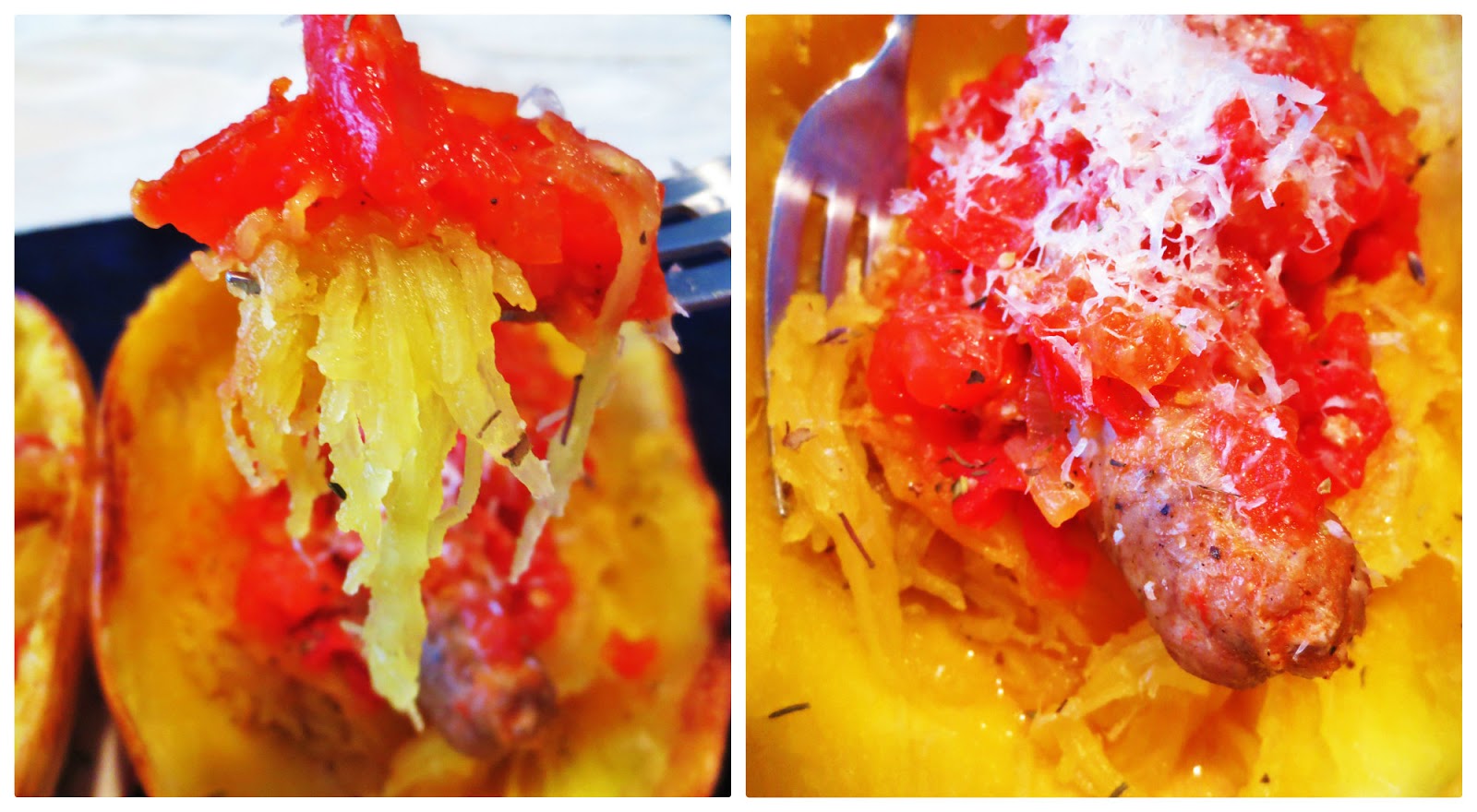
When your squash is done, remove from the oven, and let it cool for 10-15 minutes. Once cool, take a large serving spoon, and scoop the strands from the skin. Transfer to a large bowl and drizzle with 1T olive oil. Salt and pepper to taste. See the strands! Just like real spaghetti!


When the sauce has finished cooking, I like to scoop some of the squash strands back into the skins to serve. They're just like bread bowls from Panera, and make for a great presentation. Top with as much grated parmigiano reggiano as your little heart desires. 


This is a great meal to show off your ingenuity in the kitchen. You'll be amazed at how great a substitute it is for actual pasta. The squash is not overcooked (nobody likes mushy baby food), and gives a little resistance when biting down. It really doesn't have much of its own flavor. You get a little bit of a pumpkin/butternut squash flavor, but for the most part, it takes on the taste of the marinara, which by the way is perfectly savory. Sometimes when I make marinara, I'll add a little bit of honey to offset the acidity, but given the natural sweetness of the squash (and the sausage), I decided not to. The tomatoes are crushed and smushed and wonderfully hearty with a nice kick from the crushed red pepper. And lastly, the sweet Italian sausage. If you've had it, you know what I'm talking about. If you haven't, go buy some. These are from this wonderful shop in Arlington, VA, that my grandma used buy from when she lived there. She used to serve these for Christmas dinner with spaghetti and meatballs or her famous lasagna. The gentle fennel seed flavor is really the mark of a good sweet sausage, and it comes through with stunning clarity against the other flavors.  This is such a great meal. I felt fully satisfied, wasn't hungry later, and heck, anytime you can use a vegetable in place of a grain, I'm definitely in. 

Questions, comments, concerns below. Buon appetito!

Smoky Crab and Tomato Bisque with Sage Goat Cheese


With the rain yesterday, I really wanted a bowl of something warm to cozy up to. I know what you're thinking. Soup when it's 85 degrees out? But just hear me out: all the ingredients are in season now, so you won't get them this fresh any other time of year, and it's so easy, you'll wish you could make it all year round. Crab is obviously great in the summer and the tomatoes my aunt gave me were just perfect. The term bisque refers to a type of soup originating in classical French cuisine. It is a creamy seafood soup that usually has a smooth consistency and is made from seafood stock. It is also sometimes incorrectly used to refer to creamy soups made from pureed, cooked vegetables like butternut squash. I cut a few corners in mine that I'll explain later because 1. sometimes you're just not in the mood to make everything perfect, and 2. sometimes you just don't have time. I will say this though, there is always a time and place to really put a lot of effort into your meals, and I try to do that as often as possible, but sometimes you just can't for whatever reason. Besides, you're a hard-working cook; you deserve delicious food as soon as you can make it! Alright enough, onto the food...

I started by opening a bottle of pinot noir to drink to let it breathe. This is one of the lightest red wines, and for this recipe, we're going for as light as possible with the ingredients since it's a cream-based bisque. Then I heated 2tsp of olive oil in my large cast iron skillet. Ok, side note: if I had to choose a favorite kitchen tool, it would probably be a three-way tie between my microplane, my large chef's knife, and my cast iron skillet. Seriously, there is just something magical about the flavor a seasoned skillet imparts. And since it is one solid piece of iron, it evenly distributes the heat over the surface of the pan more so than any cooking pan I've used. 

Once your oil is nice and hot, add one medium diced white onion and a large pinch of salt, and walk away from the pan. You want the onions to slightly caramelize and if you move them around constantly, they won't have a chance to keep contact with the pan in order to do so. (TayTip: only salt your onions when you want to caramelize them. Salting them releases their water content and allows the natural sugars to caramelize.) They will start to brown and burn in some places, but that's ok because you will deglaze the skillet with 2 cups of the pinot noir. Then add 5 large diced red tomatoes. Don't worry about dicing them too small because they cook down. Make sure to put all the juice and seeds in the pan too. You want as much moisture as possible, and tomatoes are a very juicy fruit. Then add 2tsp of smoked Hungarian paprika. This is an incredible spice, and I recommend using it in place of your typical paprika. If you've ever had a burger from a charcoal grill as opposed to one cooked on a stove, you know what a difference the smoked flavor can give. Cook uncovered over medium-high heat for 10-15 minutes until it reduces by 1/3. Use the back of a wooden spoon to occasionally smush the tomatoes as they cook down. 


Now take this base for your bisque, transfer to a blender or food processor, and pulse a few times until the large chunks of tomato and onion are smooth. If I was making a traditional bisque, I would take a mesh strainer and strain out the seeds and any pieces of tomato not pureed, but this is where I cut a corner. Transfer your pureed sauce back into the pan and put the heat on low. Next, add 1tsp of crushed red pepper flakes. It's important to add them after the pureeing process so that they have time to slowly release their spice. Then add 1cup of cooked crab meat. Lump, claw, it doesn't really matter, use whatever type of meat you like. This is an easy meal, remember? And last but not least, add 1cup of heavy cream. Here's where the decadence comes into play. Now let it sit because if you're making this to eat immediately like I was, this is the only time the flavors will have to meld together before you get the first meal out of the bisque.  


If you noticed, I really haven't added much seasoning to the bisque other than salt, paprika, and crushed red pepper. I didn't even use garlic, people, so that should've been a red flag! This is because I don't want anything to overpower the gentle, sweet flavor of the crab meat. It's very easy to obstruct that flavor with loads of garlic and a lot of herbs, so I decided to stick to a single vein and only add one herb at the end. This is where the sage goat cheese happens. This is very similar to a compound butter, and is just as easy to make. First take your goat cheese out of the fridge so it can warm up a little. Setting it beside the warm stove burner works perfectly. Then take 18-20 small sage leaves and chop them as small as you can get them. Almost like a paste (TayTip: you can chop the sage much more easily by stacking the leaves on top of each other in a single pile). You should have a little less than 1/4 cup at the end. Mix with 10oz. of goat cheese and 1tsp of cracked black pepper. To store, lie a long piece of saran wrap over a cutting board and pile the mixture on top. Take one side of the saran wrap and fold it over, then slowly roll and mold the cheese until you have a log shape, folding over the other piece of saran wrap. Twist the ends and store in the fridge. This allows you to slice little medallions to place atop the hot bisque. 


The next step is to EAT this delicious bisque. Slice a couple of goat cheese coins and set them right on top of your steaming bowl. 


As the cheese melts, the sage reaches the warm orange lava and its earthy, woodsy flavor turns into perfume. If Kennedy could put a man on the moon FORTY-FOUR years ago, why haven't we developed smell-o-vision yet? But I digress. Sage has also been used in teas, salves, and aromatherapy for centuries to calm nerves and reduce anxiety. Perfect for bisque on a rainy day, right? I can't tell you how wonderfully sweet the crab meat is. You really need to make this! The Hungarian paprika gives just enough punch to have a little tussle with the sweet crab and tangy goat cheese. The ultimate fight for flavor. But the little kiss of pinot noir makes everyone shake hands at the end of the match...I mean meal. The next time you want something warm and flavorful on a rainy day, make this bisque...tomato soup will never seem the same.  Buon appetito!


Slow Cooker Boneless Short Ribs with Walnut Basil Pesto


Can we just stop to have a little applause for alcohol? I mean is there anything that it can't make taste phenomenal? Seriously. And not just any alcohol, wine. White in this case. When it comes to wine and meat, they're basically a match made in culinary heaven. Ok, let's be honest, anything cooked with alcohol is a match made in  culinary heaven. I don't have a problem, I promise! Try incorporating wine into the cooking process of your next dinner (and I don't mean drink it while you're cooking, although that is an acceptable practice in my book 99% of the time) and taste the insane flavor it imparts. You can't beat it. Nothing can mimic that taste. 

Since I made fish earlier this week, and that's usually what we have on Fridays for dinner, I decided to go the opposite direction and cook some good ol' red meat. I saw some boneless pork short ribs and decided they looked impeccable. And let me just tell you, the slow cooker is a godsend when cooking pork. Like scrambled eggs, they're best cooked slowly. Giving the connective tissue time to break down over a period of time in the cooker produces a juicy and tender rib (TayTip: get your butcher to leave a little bit of marbling--the white fat--on the ribs if you know you're not going to be cooking them for a couple of days. The fat helps retain moisture within the muscle). BUT, you always have to have a good flavorful topping/sauce to go with your ribs. I wasn't really feeling typical BBQ sauce, so I decided to make my pesto. Incorporating pesto with meat is a great use of this versatile Italian sauce. So let's start there...

This pesto is the traditional recipe that originated in Genoa, Italy, except for one ingredient. The name literally means to pound or crush, referencing the conventional preparing vessel used: a mortal and pestle (see the same prefix?) A mortal and pestle is currently on my wishlist, so I use a food processor. Doesn't give as rustic a consistency, but it does the trick. So, put about two cups of basil leaves, the juice of 2 small lemons, and 4 raw garlic cloves into your processor and pulse until the basil is broken down. 


Now for the salty part: freshly grated parmigiano reggiano. This is not the stuff in the bottle with the green lid, which can be good for other recipes, but not this one. The difference is that parmigiano reggiano is made under strict Italian Denominazione di Origine Controllata ("controlled designation of origin") laws--kind of like the USDA. You know how champagne can only be called such if it's made in the Champagne region of France? Same thing with parmigiano reggiano. It must follow the rules and be made in certain regions in Italy; Parma, Reggio-Emilia, and Modena to name a few. SO this is the real deal good stuff! You'll need about 1/4 cup grated right into the processor. Pesto is customarily made using pine nuts, but I didn't have any, so I decided to toast some walnuts and throw them in instead (TayTip: chefs often do, and you can make non-traditional pesto using different herbs and nuts. I've done sage and almonds before and it turns out great, so don't be scared to deviate a little. Especially if you have an allergy to a certain nut). The last step is to add a small pinch of salt because the cheese is very salty, some pepper, and turn the processor to the "ON" position. As it's running, slowly stream in 1/2 cup of olive oil. It should be somewhere between a loose vinaigrette and a paste, but you can tweak the oil and add more or less depending on how you like your consistency. 


 Put it in a container or bowl and drizzle more oil on top; you always want to cover leftover pesto with oil to keep it from drying out. This can obviously be used in a plethora of different dishes: pasta, salads, as a marinade, or simply as a dip with veggies or your favorite chips/crackers.  Let it sit in the fridge until you're ready to eat it with your meat. 

Speaking of which, let's move onto the meat. Start by quartering 1 1/2 medium white onions and roughly chopping 4 garlic cloves. Place your ribs in the slow cooker and season with a pinch of salt, couple twists of black pepper, and drizzle with a little olive oil. No exact measurements needed here, but don't put too much oil. The pesto already has oil in it, and the meat has fat on it. Then wiggle 2-3 stalks of fresh rosemary and thyme, respectively, on the bottom of the pan. Don't worry about removing the leaves or sprigs because they will be submerged and fall off in the cooking process. Throw your onions and garlic in, and sprinkle with 1tsp of crushed red pepper flakes. Then tuck your little piggies in with a nice blanket of Pinot Grigio. 2 cups to be exact. They won't be completely covered at the start, but will cook down. Set the cooker on high, cover, and let it work its magic for 4 hours. 


The pork just melds with all of the delectable elements in the cooker. It's important that the meat have a flavor element of its own, and not just take on the flavor of the pesto. So, that's why the herbs (whose stems you can fish out of the cooker at this point) onions, garlic, wine, and red pepper flakes are key players on the field. There will be a lot of broth left in the bottom of the cooker. DON'T throw that away. Put it in a container and freeze it; the next time you get sick, you'll have a good broth packed with vitamins and protein. Once the meat is finished, it will fall apart slightly. 


For two reasons that stand out to me, this is probably one of the best dishes you can make. One, it's done in the slow cooker and you can get on with your life while it's working away. And two, you just can't beat the flavors of wine and fresh herbs. The pork is so tender you could cut it with a wooden spoon. It tastes like the crisp pinot grigio and the sweet undertone of the onions. The smell of the rosemary and thyme remind me of Thanksgiving, but paired with the basil pesto, there's no mistaking this is a summer dish. The tang of the lemon is also pretty prominent in the sauce, and toasting the walnuts takes away their bitter taste, so they do well in replacing the pine nuts. These are pork ribs taken up a notch without the gloppy BBQ sauce. Who needs all that heaviness when you can have juicy meat topped with the lightest freshest sauce around? Buon appetito!

Fontina Caprese with Basil Pesto

So I made this fairly simple and straightforward snack for lunch yesterday, and it was all I needed. Everyone knows what a caprese is, but I gave mine a little taste update. Instead of the traditional mozzarella, I used fontina which is sweet, nutty, and not as mild as mozzarella. I also used pesto instead of the usual drizzle of olive oil. While the oil has a wonderful taste, I wanted a little kick. And once again, I had gorgeous fresh ingredients courtesy of my Aunt Happel. I mean, seriously, look at those tomatoes; the color is insane. And the taste and texture are even better. Speaking of which, let's have a little chat about tomatoes. Rich in lycopene, an antioxidant that some call the wonder antioxidant, tomatoes are one of the world's healthiest fruits. Being from Richmond, I consider myself a tomato snob with the world-famous king of tomatoes, the Hanover, grown right in my backyard north of the City. They're sweet and I can literally eat one like an apple. And let me tell you, the ones my aunt brought me are just perfect. Smooth and not white, but ruby red, inside; and no grittiness to be found. 

So the trick to getting a good flavorful caprese is to layer the flavors. And I'm not talking about the assembly process, I'm talking about maximizing the flavor of each ingredient. Take your bread, for instance, and toast it in the oven or toaster just enough to give it a little crunch, but not make it hard as a rock. Right as soon as it comes out, take a whole garlic clove and rub it on the surface of the hot bread. The crust will slowly scrape bits of the clove off and infuse that glorious bit of spiciness into the bread. So first flavor layer completed. Next, take your favorite pesto, or make your own, (recipe for mine will be in the next post) and spread a small amount on the warm bread. Not a lot, because you don't want any part of this to overpower any of the others. Then slice your tomato and put a little black pepper on top and place atop the pesto (TayTip: never salt your tomatoes in a caprese or any sandwich--unless it's just a tomato sandwich, in which case the salt would enhance the sweet flavor--because the cheese, pesto, and bread all have salt, and you don't want too much savory and not enough sweet). Then put a couple slices of fontina cheese and finish with one whole basil leaf. 

You've never had a caprese like this! The crusty bread up against the soft tomatoes and crisp basil leaf is just perfect. The flavor profile with the sweet homegrown tomatoes, peppery and slightly minty basil, spicy garlic, and the nutty cheese is an immaculate combination. The pesto underlines the basil and the bread is the perfect vessel. Try this shaken up caprese and give your taste buds a reward! Buon appetito!

Broiled Cod with Sweet Onions, Cherry Tomatoes, and Tzatziki Sauce


With summer winding down, I realized that other than a salmon cake fiasco a couple months ago, I hadn't made a really good fish yet. I wanted to broil something with the gorgeous cherry tomatoes my aunt grew in her garden. Side note: I have to give a shout out and thank you to my Aunt Happel for bringing me a great assortment of some magnificently verdant fresh herbs (thyme, sage, rosemary, and a big bunch of basil--I'm feeling some short ribs with a pesto rub coming to a blog near you very soon) and some glowing, crimson tomatoes. You can't beat home grown! So back to the fish:  when it comes to fish and broiling, you really need something like cod or catfish that will hold up to the high temperature and won't turn into mush like flounder or tilapia would. I also recently saw some very enticing dill fronds at the store, and bought them in bulk, so I needed a dish to utilize them before they weren't fresh anymore. That's where the tzatziki sauce comes in (explanation below). So with the stars aligned, I set out to avail myself of all these fresh ingredients whose powerful flavors go a long way!

The first step is to crank the heat on your oven to broil (or 500 degrees F); you want it very hot when the fish goes in. Then take one large sweet onion, and cut it into about 1/3 inch slices. You want about 9 or 10 altogether. Then line the discs in rows of 3 on a baking sheet drizzled with extra virgin olive oil. Lay your cod fillets on top and toss some cherry tomatoes around the sheet. Drizzle with a little more oil, pinch of salt and a few cracks of pepper. Squeeze half a lemon all over and toss the half onto the sheet. It will perfume the oven and help the lemon flavor to permeate more. Then take some fresh thyme sprigs, remove the leaves (TayTip: you can easily remove the leaves by pinching one end of the sprig and stripping them off with the index finger and thumb of your other hand. Make sure to go "against the grain." You'll be able to tell if you need to run your fingers the other way.) and sprinkle freely on top of the fish. Thyme has a subtle lemony taste to it, so it compliments the lemon juice very well.  Take some aluminum foil and tent it over the top of your baking sheet. This keeps some of the steam in to keep the fish from drying out and helps the thyme from burning too quickly. Broil for about 10-15 minutes, but keep an eye on it because it goes fast. Your fish should be white and flakey when done.


Now for your tzatziki (pronounced zad-ZEE-kee) sauce.This is a classic Greek dish and is traditionally served with kebobs, inside gyros, or merely as a first course with pita bread. This is literally one of the easiest sauces you will ever make. It only has five ingredients! Let me say that again, FIVE! Excluding salt and pepper, which don't really count because they're in everything. You will be able to make this sauce with time to spare in the time it takes the cod to cook. Tzatziki is traditionally made with fresh mint and parsley along with the dill, but I don't like too many conflicting herbs in mine (because when they're fresh, they have a much stronger flavor as opposed to dried), so I went a little off the beaten path. It also customarily calls for olive oil swirled in (not fully incorporated), but I find that's only really necessary when serving it as a dip with pita bread. 

First start by taking two big handfuls of dill--about 1 cup--and remove the larger stalks at the bottom. Run your knife through the bundle a few times, enough to break it up. Next take one large cucumber and dice it small. Then zest one lemon. In a large mixing bowl add 3 cups of greek yogurt and incorporate your three previous ingredients. Then finely mince 7-8 small or 3 large garlic cloves and mix well. If you like more or less of any ingredient, add or subtract to your desire. You're the one eating it! Salt and pepper to taste and you're done. 


This is probably one of the easiest, yet most flavorful dishes you can make. And let's face it, when it's the middle of the week, you want something filling and scrumptious that you can prepare quickly.


The first thing I noticed about the flavor of the fish was that the sweetness of the onions and tomatoes really pops in the forefront, which is surprising since this is a savory dish. Top it with the tzatziki and it's exceptional. Cod really has the springy texture of lobster or crab claw meat when cooked. It gives a tiny bit of resistance when you bite down, which is what I meant when I said it doesn't turn to mush. The thyme is just subtle enough to boost the lemon flavor that is prevalent throughout. The tzatziki has a little zing from the fresh garlic, and isn't heavy at all because of the brightness that the lemon zest and juice bring. The slightly sour dill tastes like a mix of parsley and fennel, and adds a great depth of flavor. Plus, you can't beat the crunch of a fresh cucumber! I'm not kidding when I say this is a very easy and fast dish to make. If you want a perfect summer fish dinner, this is the way to go. Fresh, light, and satisfying. Buon appetito!


It's So Hot...Drunken Roasted Peach Froyo Was a GOOD Choice


If you get the reference in that title, good job. If not, it's a quote from the movie Anchorman.


Basically July in Richmond is hotter'n the brass hinges of hell, so I decided to make something cool and refreshing. Plus, there's alcohol in it, so win-win! And not just any alcohol, my favorite kind: red wine. It's also peach season right now, and those little firey globes are aflush with yellow, orange, and red skins, just waiting for you to pick 'em and make this creamy froyo loaded with roasted deliciousness. 

First start by slicing your peaches lengthwise and pitting them. I use the opposite end of my melon baller. This side is used to do melon decorations, but it works perfectly for sliding under the pit and slicing it out.


Then drizzle some extra virgin olive oil on a cookie sheet and place the peaches flesh side down. Put a little dollop of raw honey on each half and drizzle with some Chianti wine. Place the sheet in a 400 degree F oven and roast for 20-25 minutes. 


They will look like this when done. The golden, velvet skins will have shriveled a bit and pulled away from the flesh, which is soft and charred on the edges. Let them cool for at least 20 minutes (explanation later).


Peach heaven.


Now for the additional drunken part of these drunken peaches. You'll want to make a Chianti caramel. I KNOW, RIGHT? No more words are necessary about how great that is. 


Start by melting 1.5T butter in a pan with 4oz. of the Chianti (TayTip: 4oz is the liquid equivalent of 1/2c). Add 2T brown sugar and 2tsp of pure vanilla extract. 


Then grate some fresh whole nutmeg into the pan. About 1tsp. 


Cook over medium-high to high heat until boiling then remove from the heat immediately as the sugar can burn very quickly. 


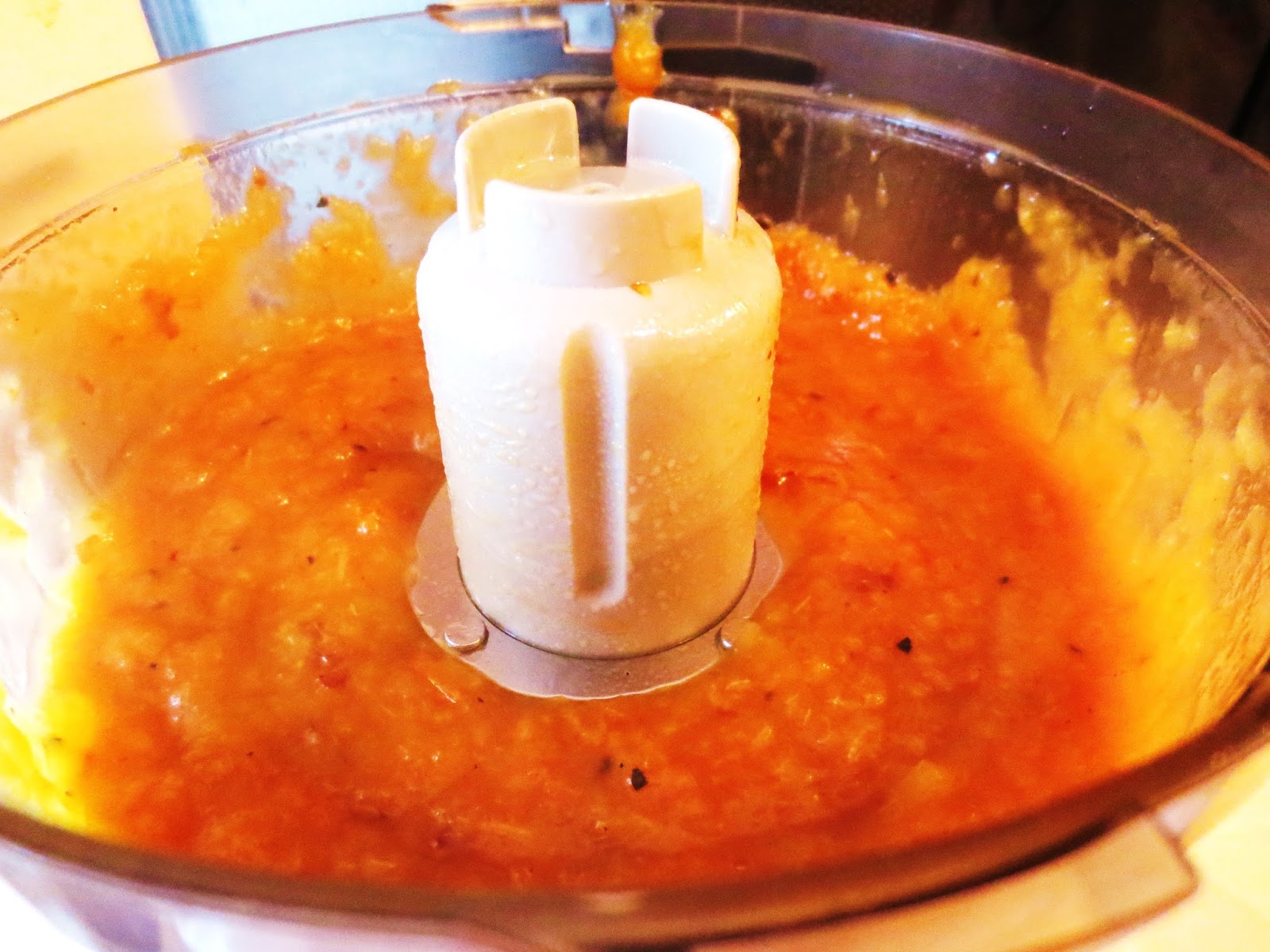
Now back to the cooled peaches. Toss them skins and charred parts and all into a food processor or blender and puree until smooth. 


Will look like this when finished. (TayTip: at this point you could use the peach puree as a marinade or sauce for pork, chicken, or fish)


Then add your gorgeous, tawny caramel and blend until incorporated. 


Now for the "yo" part, and the reason why the peaches had to cool. If you mix piping hot peaches with cold yogurt, it is going to separate. As in curds and whey, and I don't see Little Miss Muffet anywhere, so it's best to take your time with this one. Add 2.5 cups to the peach mixture and blend. 


Pale and sunny. 


The last thing to do is put it in a container in the freezer for at least 4 hours, but overnight is best. (TayTip: use the old yogurt container to store some of the froyo in the freezer)


The peaches are no longer sour because the roasting process eliminates most of the initial acidity, but they have this incredible depth of flavor. The Chianti is a dry red wine, but still very fruity, and melded with the molten brown sugar to create a caramel, it's just insane. The nutmeg doesn't really have a flavor comparable to anything else; it's incredibly nutty. If you've ever had eggnog or a béchamel, you know how great nutmeg is with cream. Top with strawberries, shaved dark chocolate or just enjoy this froyo on it's own. Cool down with this perfect treat for the sweltering later summer months! Buon Appetito!

Popular Posts

Followers

Copyright Taylor Maria Schultes 2013. All rights reserved. Powered by Blogger.